Michael Jordan & Oil: The Law of Comparative Advantage

Originally published in Flourishing March/April 2010.

First, consider these facts:*

  • Just 18% of our oil imports come from the Persian Gulf.
  • The US produces 74% of all the energy it consumes.
  • Because only 26% of our energy is imported, only 4.7% of US primary energy comes from the Persian Gulf. (18 x .26 = 4.68)
  • There are 173 net oil importers in the world.  So, if the US quit buying oil on the world market, there would still be 172 net oil importers.
  • Crude oil contains about 18,400 Btu’s per pound.
  • Corn contains about 7,000 Btu’s per pound.
  • Wind-generated electricity may cost more than twice as much to produce as much electricity from plants fired by natural gas, nuclear, or coal.

Now, what is the law of comparative advantage, and why does it matter?

The law was first identified and formulated by the great British economist David Ricardo to explain that international trade and the division of labor are mutually advantageous to two or more countries, even if one is superior to the others in production of virtually any commodity, product, or service.  In fact, the law applies to any situation involving the division of labor.

In his prime, Michael Jordan could play baseball better than 99% of all Americans.  He did, in fact, earn a tidy sum of money playing minor league ball; but just about the same as others with similar ability.  In basketball, though, Michael was the greatest player who ever lived.  In basketball, the skill differential between Michael and the other players was much greater.  As a result, Michael had more fun and made far more money playing basketball than baseball.  Baseball was not hurt by Michael’s absence, and basketball was elevated immeasurably.  That’s the law of comparative advantage.

The countries of the Persian Gulf are the Michael Jordan of oil—they have more oil than any other region of the globe.  But, they don’t have much fresh water or arable land.  In agriculture, they are, at best, minor league.  For the sake of illustration, let’s assume that it costs those countries less than $10 per barrel to extract oil from the ground.  Let’s also assume that producing corn, to whatever extent they might be able to do that, costs them at least $3.50 per bushel.  If, based on world market prices, they can sell corn for $3.50 and oil for $75, their comparative advantage is clearly the production and distribution of oil. 

What about us?  Ignoring the fact that access to many of our own reserves is limited by the government, the United States itself has vast reserves of oil and other fossil fuels.  The costs of bringing oil out of the ground in the U.S. vary widely, but let’s say the range is from $15 per barrel to $200 per barrel.  With a market price of $75 per barrel, at what point does it make economic sense to import oil from the Persian Gulf countries?  The obvious and correct answer is. . .

. . . anytime our cost of production exceeds the market price (in this case $75), we should purchase any additional oil we need—whether from Mexico, Canada, or any other country—in the world market for oil.

Producing oil domestically at a cost greater than that at which we can buy it overseas makes no sense.  Nor do we benefit in the slightest degree from the attempt to attain energy independence via subsidized “alternative energy”.  In either case, we simply increase our own energy costs.  More importantly—like Michael playing baseball—we divert significant capital and human resources from industries where they could be employed more productively.  In my opinion, growing corn for ethanol, instead of for food, is but one glaring example of such misallocation of resources.  The “green jobs” boondoggle is another. 

In sum, I believe it surely is true that we can and should produce a significant supply of energy right here in the U.S., but the law of comparative advantage tells us that the quest for energy independence is a fool’s errand.  mh
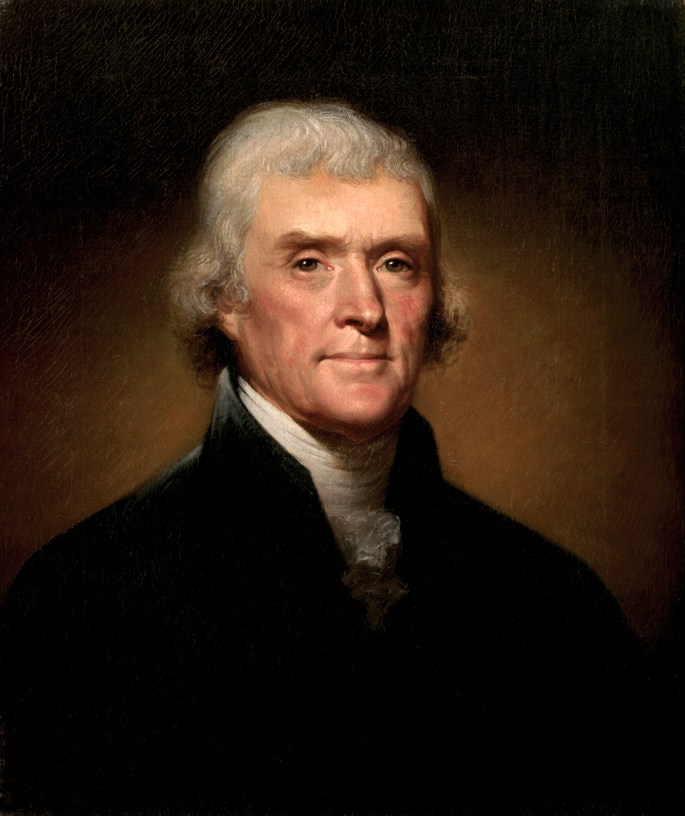
Jefferson’s First Principle of Association

Originally Published in Flourishing July/August 2010

“To take from one, because it is thought his own industry and that of his fathers has acquired too much, in order to spare to others, who, or whose fathers, have not exercised equal industry and skill, is to violate arbitrarily the first principle of association, the guarantee to everyone the free exercise of his industry and the fruits acquired by it.”  

—Thomas Jefferson, letter to Joseph Milligan, April 6, 1816.

Larry Summers served briefly as a Secretary of the Treasury under President Clinton, and later as President of Harvard University, where he got into trouble for inadvertently hinting that boys might have a greater natural aptitude for math and science than girls. He is now a key, behind-the-scenes economic advisor to President Obama, having lost out to Tim Geithner as Obama’s Treasury Secretary.

In a New York Times article, The Return of Larry Summers, published on November 26, 2008, David Leonhardt told his readers about one of Summers’ favorite economic arguments: Require every household in the top 1% of American income earners, who as a group have an average annual income of $1.7 million, to write a check for $800,000. This money could then be pooled and used to mail a $10,000 check to every household in the bottom 80 percent of income distribution, those making less than $120,0001.

Leonhardt’s story may only be symbolic, but it is instructive. I see several problems with Summers’ idea.

First is the fact that the $1.7 million is an average. Many households earning less than $500,000 are also in the top 1%. The threshold income to be in the top 1% was $410,096 in 2007, the latest year for which data is available2. Their tax rate would not be the roughly 47% envisioned by Mr. Summers; it would approach 195%. (It’s an important fact, too, that the makeup of the top 1% is constantly changing, as people with new ideas and special talents migrate from the lowest levels of income distribution to the top.)

Second, I believe that Mr. Summers is advocating government-sponsored armed robbery on a heroic scale. I suspect that many among the top 1% might resist having their earnings from whatever source – intellectual and artistic endeavors, business interests, professional practices, or investment, for example – snatched so imperiously. After all, does Summers’ proposal differ in any basic respect from private citizens taking the matter of income inequality into their own hands? It’s probably true that rich people won’t draw their six-shooters to defend their income from the government, but they might well vote with their feet. Talent and Capital tend to reside where they’re treated best.

Third, it’s widely known that Warren Buffett, the world’s third richest man, is very conservative in his personal spending habits, as was Sam Walton, the founder of Walmart.3 Those two may be exceptions of a sort, but the few hundred mansions, yachts, and airplanes belonging to others among the top 1% pale into insignificance alongside the total consumption of the general population. Moreover, a significant portion of the consumption of the wealthy, who are so often demonized as greedy fat-cats, takes the form of support for universities, hospitals, research facilities, theater and music companies, museums, libraries, and churches; to name just a few of their non-profit pursuits.4

Finally, contrary to the myth of conspicuous consumption, most of the wealth owned by the top 1% is held in the form of business, financial, and industrial assets.5 The wealthy and their productive capital can serve consumers throughout the world by producing a vast array of goods and services, or by financing that production, or by paying the wages, salaries, and benefits of a substantial percentage of America’s workforce. The intended beneficiaries of Summers’ scheme should already enjoy a magnificent range of benefits derived from the savings and investments of all Americans, including the invested wealth of those at the top.

I believe that widespread understanding of this issue is critical for America’s return to lasting prosperity; and that economists like Larry Summers and politicians like Barack Obama simply do not appreciate (or care?) that their redistribution policies may limit the formation of productive capital and the creation of well-paying, private-sector jobs. The history of forced wealth and income redistribution is replete with examples.6

In my opinion, Summers’ favorite economic argument does not really benefit the bottom 80%. Rather, forced redistribution of wealth and income consumes the savings and capital of America’s most productive citizens, or drives it and them offshore. My reading of history indicates that such policies have no lasting beneficiaries, only victims. And, most importantly, I believe Thomas Jefferson observed correctly that the forced redistribution of wealth and income is a first-order violation of human rights. mh

1 http://georgereismansblog.blogspot.com/.

2 http://www.ntu.org/tax-basics/who-pays-income-taxes.html.

3The World’s Billionaires, Forbes Fact and Comment, March 10, 2010. 

All the Money In the World, Peter Bernstein (editor), Knopf, 2007.

4 Caroline Bermudez, “Wealthy Are Making Bigger Gifts to Charitable Causes”, Chronicle of Philanthropy, July 1, 2010. (http://philanthropy.com/article/Wealthy-Are-Making-Bigger/66112/).

5http://sociology.ucsc.edu/whorulesamerica/power/wealth.html

6 The Ascent of Money: A Financial History of the World, Niall Ferguson, Penguin, 2009.